How X-rays are made: the spectrum
Bremsstrahlung continuum and tungsten characteristic lines, maximum energy = kVp, ~1% efficiency, what shapes the spectrum
The shot
In one line
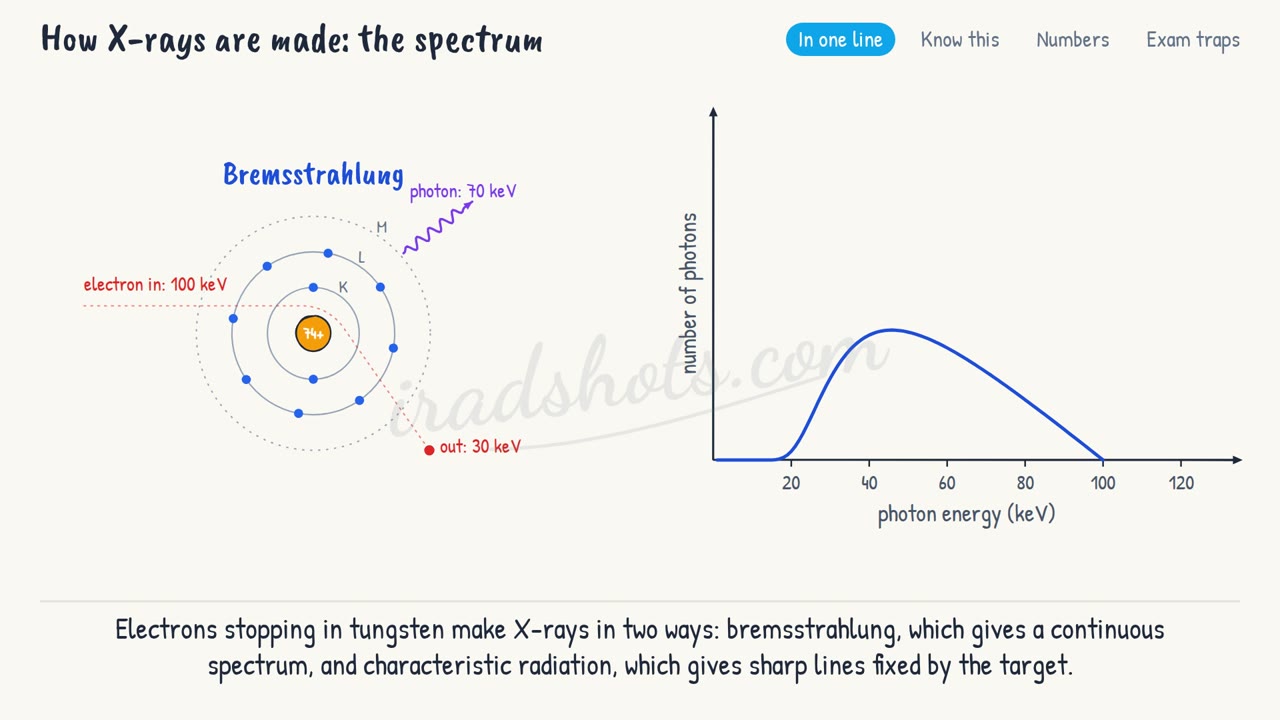
Electrons stopping in tungsten make X-rays in two ways: bremsstrahlung, which gives a continuous spectrum, and characteristic radiation, which gives sharp lines fixed by the target.
Know this
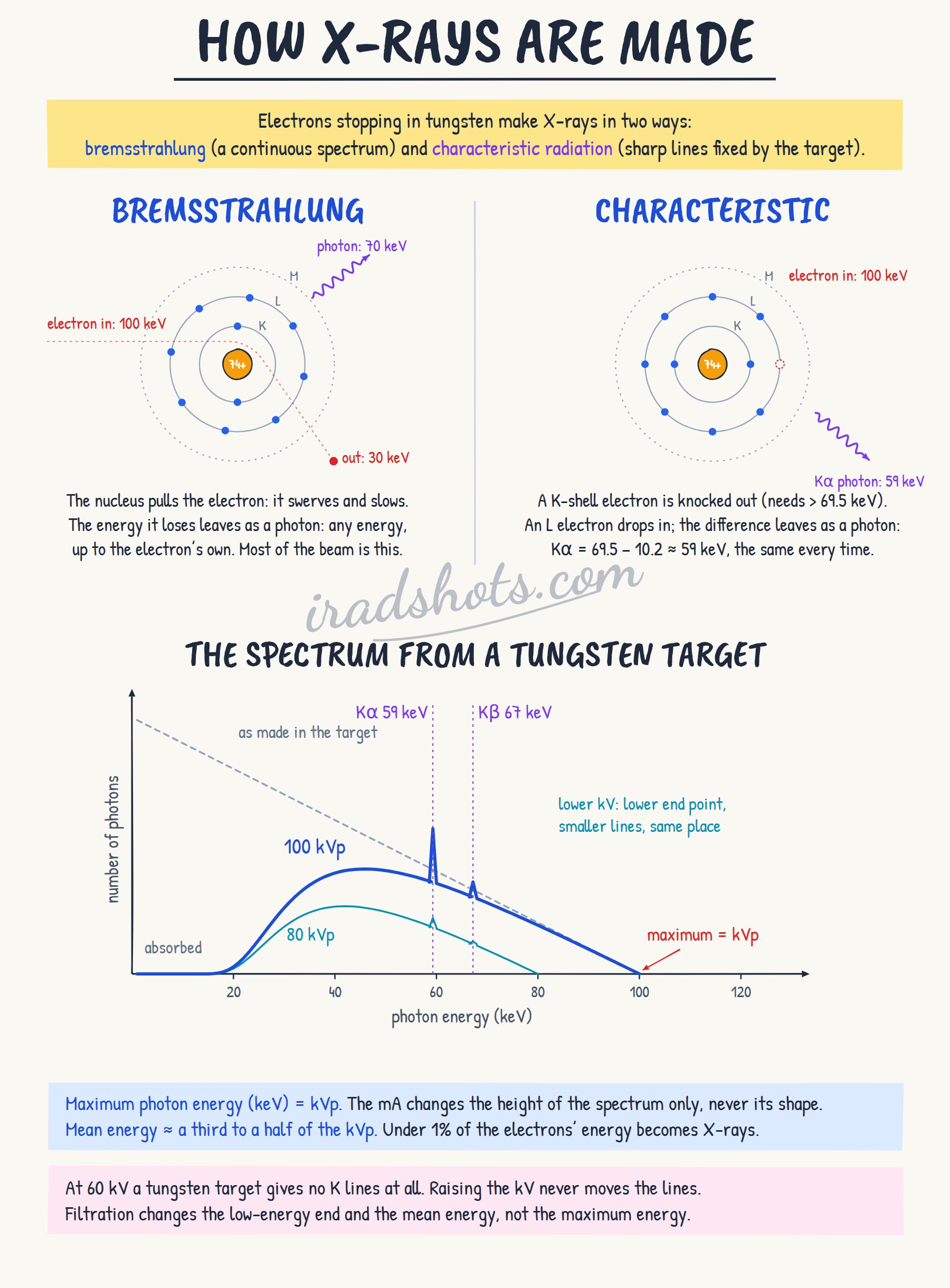
- Bremsstrahlung: the electron is slowed by the pull of a nucleus, and the energy it loses leaves as a photon. Any energy is possible, so the spectrum is continuous.
- The maximum photon energy in keV equals the kVp. Nothing else changes it.
- Low-energy photons are absorbed by the target, the window and the filters, so the emerging spectrum starts at about 10 to 20 keV and rises to a hump.
- Characteristic radiation: the electron knocks out a K-shell electron, an outer electron drops in, and the difference in binding energy leaves as a photon.
- The line energies depend on the target element only. The kV changes their height, never their position.
- Most of the beam is bremsstrahlung.
- Output rises with the atomic number of the target, roughly with the square of the kV, and in proportion to the mA.
Numbers
- Tungsten K-shell binding energy: 69.5 keV, so K lines appear only above 69.5 kV.
- K-alpha: about 59 keV. K-beta: about 67 to 69 keV.
- Tungsten L lines: about 8 to 12 keV, absorbed by the filtration.
- Mean photon energy: about a third to a half of the kVp.
- Efficiency at 100 kV: under 1%.
Exam traps
- The mA changes the height of the spectrum only. It never shifts it.
- Raising the kV does not move the characteristic lines.
- At 60 kV a tungsten target gives no K lines at all.
- Filtration changes the low-energy end and the mean energy, not the maximum energy.
Sketch
Check yourself
As in the exam: mark each item true or false. Any number can be true.
1. Concerning bremsstrahlung:
- aIt makes up only a small fraction of the photons in a diagnostic beam.
It is the large majority; characteristic radiation is the small part.
- bIts production increases with the atomic number of the target.
The stronger the nuclear charge, the more braking; output is roughly proportional to Z.
- cIt occurs when an incoming electron ejects a K-shell electron.
That starts characteristic radiation; bremsstrahlung comes from deceleration in the field of a nucleus.
- dThe maximum photon energy in keV equals the tube kVp.
A photon cannot carry more energy than the electron that made it (the Duane–Hunt limit).
- eIt produces a continuous spectrum of photon energies.
An electron can lose any amount of its energy as it is slowed by a nucleus.
2. Characteristic radiation from a tungsten target:
- aThe K-alpha line has an energy of about 59 keV.
It comes from an L-shell electron filling the K shell (about 58 to 59 keV).
- bK lines are produced at a tube voltage of 60 kV.
The electrons must exceed the K-shell binding energy of 69.5 keV, so the tube needs more than 69.5 kV.
- cK-beta photons have a higher energy than K-alpha photons.
K-beta comes from an M-shell electron, which falls further than one from the L shell.
- dThe energy of the characteristic lines rises as the kV is increased.
The line energies are fixed by the target element; a higher kV only makes them more intense.
- eL-shell characteristic X-rays contribute usefully to the image.
At about 8 to 12 keV they are absorbed by the inherent and added filtration.
3. Regarding the X-ray spectrum emerging from a diagnostic tube:
- aAdded filtration raises the mean energy of the spectrum.
It removes the low-energy photons first (beam hardening).
- bThe emerging spectrum has the most photons at the lowest energies, close to zero keV.
Those photons are absorbed in the target, window and filters, so the emerging spectrum starts at about 10 to 20 keV.
- cThe mean photon energy is about one third to one half of the kVp.
For example, roughly 30 to 40 keV for an 80 kVp beam.
- dIncreasing the kVp increases the area under the spectrum.
Output rises roughly with the square of the kV.
- eIncreasing the mA shifts the spectrum to higher energies.
The mA scales the height of the spectrum only; its shape and energies are unchanged.
4. Concerning the efficiency of X-ray production:
- aMost of the energy deposited in the target appears as heat.
More than 99%, which is why anode cooling and tube rating matter.
- bWith a tungsten target at 100 kV, under 1% of the electrons' energy becomes X-rays.
The rest is deposited as heat in the anode.
- cEfficiency is independent of the tube voltage.
It rises with the kV.
- dDoubling the mA doubles the efficiency of X-ray production.
It doubles both the X-ray output and the heat, so the efficiency is unchanged.
- eEfficiency is roughly proportional to the target atomic number multiplied by the tube voltage.
Higher Z and higher kV both make production more efficient.
5. Compared with an old single-phase generator, a high-frequency generator:
- araises the maximum photon energy above the set kVp.
The maximum photon energy is still the peak kilovoltage.
- bkeeps the tube voltage almost constant.
The ripple is very small, so the voltage stays close to its peak.
- callows shorter exposure times for the same exposure.
More output for each mAs means the same exposure is reached sooner.
- dgives a lower X-ray output at the same kVp and mAs.
It gives a higher output, because the voltage stays near its peak.
- egives a higher mean photon energy at the same kVp setting.
Fewer electrons cross the tube at low voltages, so fewer low-energy photons are made.
The full explanation about 4 min to read
Two ways to make an X-ray
When a fast electron hits the tungsten target, it usually just loses its energy bit by bit, jostling outer electrons and making heat. But now and then it does one of two things that produce an X-ray photon. It can be swung round and slowed by the electric field of a nucleus: that makes bremsstrahlung. Or it can knock an inner-shell electron out of a tungsten atom: that leads to characteristic radiation. Plot how many photons come out at each energy and you get the X-ray spectrum, and both processes leave their fingerprints on it.
Bremsstrahlung: braking radiation
Bremsstrahlung is German for braking radiation. An electron passing close to a nucleus is pulled by its positive charge, swerves and slows down, and the kinetic energy it loses comes out as a photon. Because the electron can pass at any distance from the nucleus, it can lose any amount of energy, from almost nothing up to everything it has. So bremsstrahlung gives a continuous spectrum.
The upper limit is the key exam fact. A photon can never carry more energy than the electron that made it. With a tube voltage of 80 kVp, the electrons arrive with at most 80 keV, so the spectrum ends exactly at 80 keV. The maximum photon energy in keV equals the peak kilovoltage. This is known as the Duane–Hunt limit.
Small energy losses are far more likely than large ones, so the spectrum as it is made inside the target rises steadily towards low energies. But the low-energy photons are absorbed before they get out: by the target itself, the tube window, the oil and the filters. So the spectrum we actually get starts at about 10 to 20 keV, rises to a broad hump, and then falls almost in a straight line to its end point at the kVp. The mean photon energy is roughly a third to a half of the kVp.
Bremsstrahlung output rises with the atomic number of the target, one more reason for using tungsten. It rises roughly with the square of the kilovoltage, and in direct proportion to the milliamps.
Characteristic radiation
The second process is a collision with an inner electron. If the incoming electron has more energy than the binding energy of tungsten's K shell, about 69.5 keV, it can knock a K-shell electron right out of the atom. An electron from an outer shell then drops into the hole, and the difference between the two binding energies comes out as a photon of one exact energy.
For tungsten, an L-shell electron dropping into the K shell gives the K-alpha line, at about 58 to 59 keV. An M-shell electron dropping in gives K-beta, at about 67 to 69 keV. These appear as sharp spikes standing on the continuous spectrum. They are called characteristic because their energies are fixed by the target element. Change the kilovoltage and the spikes grow or shrink, but they never move. Change the target, and they do.
Two exam details. First, tungsten's K lines only appear when the tube voltage is above 69.5 kV. Below that there is no K-characteristic radiation at all, only bremsstrahlung. Second, tungsten also produces L lines, but at only about 8 to 12 keV, and they are absorbed by the filtration, so they play no part in the beam. Even at 80 to 100 kV, characteristic radiation is only a small part of the beam. Most of it is bremsstrahlung.
In mammography the target is often molybdenum or rhodium, whose characteristic lines lie at about 17 to 23 keV, just where breast imaging wants its photons. We will see why in the mammography lesson.
Efficiency: where the energy goes
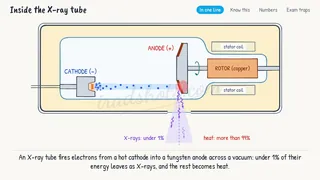
Making X-rays is very wasteful. The fraction of the electrons' energy that comes out as X-rays is roughly proportional to the atomic number of the target multiplied by the tube voltage, and for tungsten at 100 kV it is under one percent. All the rest is heat. That is why tube rating and anode cooling matter so much, and why high atomic number tungsten is the target of choice.
What shapes the spectrum
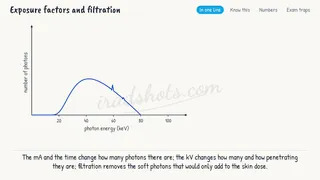
Pull this together into five dials. The kVp sets where the spectrum ends, shifts the whole curve to higher energies, and raises its height roughly with the square of the kilovoltage. The milliamps and the exposure time scale the height of the curve without changing its shape. Filtration removes low-energy photons, so it lowers the curve but raises the mean energy. The target material sets the characteristic lines and, through its atomic number, the efficiency. And the voltage waveform matters. A modern high-frequency generator keeps the voltage close to its peak all the time, so it produces more photons, at a higher mean energy, than an old single-phase supply whose voltage keeps falling to zero.
Exam traps
One: the maximum photon energy equals the kVp, and it is set only by the kVp, not by the milliamps or the filtration. Two: characteristic line energies depend on the target, not on the kilovoltage, and tungsten's K lines need more than 69.5 kV. Three: most of the beam is bremsstrahlung, and less than one percent of the electrons' energy becomes X-rays.
Sign in to keep track of the lessons you have done and your scores.