Compton scatter
Scatter off loosely bound electrons, energy vs scattering angle, electron-density (not Z) dependence, dominance in soft tissue, impact on image and staff dose
The shot
In one line
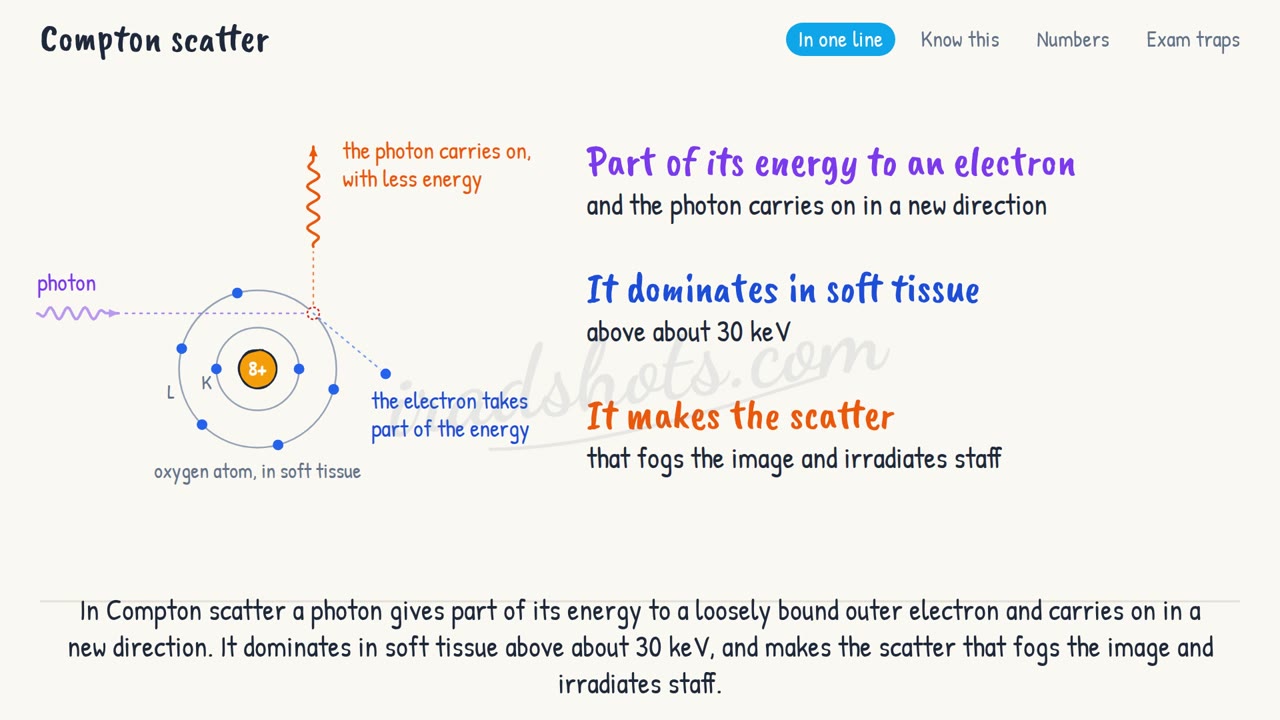
In Compton scatter a photon gives part of its energy to a loosely bound outer electron and carries on in a new direction. It dominates in soft tissue above about 30 keV, and makes the scatter that fogs the image and irradiates staff.
Know this
- The photon meets an outer electron, so loosely bound that it is effectively free, and knocks it out of the atom: the recoil electron.
- The photon is not absorbed. It is deflected with less energy, and the electron carries off the energy it has lost.
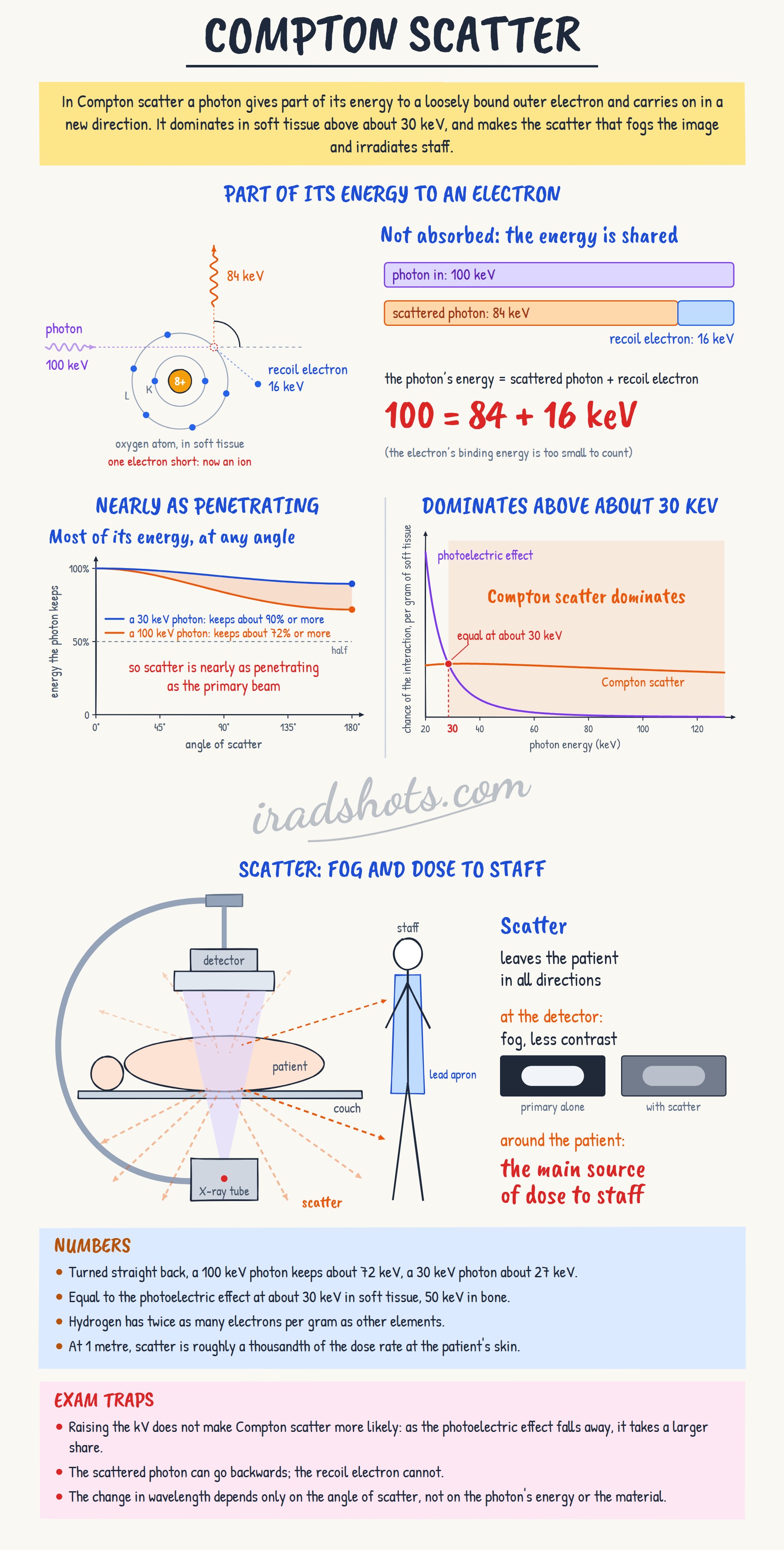
- The larger the angle of scatter, the more energy the photon loses: most when it is turned straight back, through 180°.
- In the diagnostic range the scattered photon keeps most of its energy at any angle, so scatter is nearly as penetrating as the primary beam.
- The recoil electron goes forwards or sideways, never backwards, and gives up its energy within a fraction of a millimetre.
- The probability depends on electron density, the number of electrons per gram, which is much the same in every material. So Compton scatter is almost independent of atomic number.
- Compton scatter becomes only slightly less likely as photon energy rises, while the photoelectric effect falls steeply. So in soft tissue it dominates above about 30 keV.
- Scatter leaves the patient in all directions. At the detector it fogs the image; around the patient it is the main source of dose to staff.
Numbers
- Turned straight back, a 100 keV photon keeps about 72 keV, a 30 keV photon about 27 keV.
- Equal to the photoelectric effect at about 30 keV in soft tissue, 50 keV in bone.
- Hydrogen has twice as many electrons per gram as other elements.
- At 1 metre, scatter is roughly a thousandth of the dose rate at the patient's skin.
Exam traps
- Raising the kV does not make Compton scatter more likely: as the photoelectric effect falls away, it takes a larger share.
- The scattered photon can go backwards; the recoil electron cannot.
- The change in wavelength depends only on the angle of scatter, not on the photon's energy or the material.
Sketch
Check yourself
As in the exam: mark each item true or false. Any number can be true.
1. Concerning Compton scatter:
- aThe scattered photon has a shorter wavelength than the incident photon.
It has less energy, so its wavelength is longer.
- bThe atom is left ionised.
The recoil electron is thrown out of the atom.
- cIt involves an electron whose binding energy is small compared with the photon's energy.
Such an electron behaves as if it were free; in practice it is an outer-shell electron.
- dThe energy lost by the photon appears as kinetic energy of the recoil electron.
The binding energy of a loosely bound electron is negligible, so the electron takes practically all of it.
- eThe photon is completely absorbed.
It carries on in a new direction with less energy; complete absorption is the photoelectric effect.
2. When a photon undergoes Compton scatter:
- ait loses the most energy when it is scattered through 180°.
Back-scatter: the electron then travels straight forwards with the most energy it can be given.
- ba 100 keV photon scattered through 180° is left with about 20 keV.
It keeps about 72 keV; in the diagnostic range a scattered photon keeps most of its energy at any angle.
- cthe recoil electron may travel backwards, towards the source of the photon.
It always leaves at between 0 and 90° to the photon's original direction.
- dthe change in its wavelength depends on the angle of scatter but not on the scattering material.
Nor does it depend on the photon's energy: the angle alone fixes the increase in wavelength.
- efor the same angle of scatter, a photon of higher energy loses a larger fraction of its energy.
At 90° a 30 keV photon loses about 6%, a 100 keV photon about 16% and a 511 keV photon half.
3. The probability of Compton scatter:
- ais greater, gram for gram, in hydrogen than in oxygen.
The hydrogen nucleus has no neutron, so hydrogen has twice as many electrons per gram.
- bis proportional, centimetre for centimetre, to the physical density of the material.
A denser material has more electrons in each centimetre of the photon's path.
- cdepends on the number of electrons per gram of the material.
This is the electron density, about 3 × 10²³ per gram for most elements.
- dis proportional to the cube of the atomic number.
That is the photoelectric effect; gram for gram, Compton scatter is almost independent of atomic number.
- efalls with the cube of the photon energy.
That is the photoelectric effect; Compton scatter falls only slowly as photon energy rises.
4. Concerning the importance of Compton scatter relative to photoelectric absorption:
- aImages made at a high kV show less contrast between bone and soft tissue.
More of the attenuation is by Compton scatter, which depends on density and not on atomic number.
- bIn soft tissue it is the more likely of the two at 60 keV.
They are equal at about 30 keV; at 60 keV more than four interactions in five are Compton.
- cIn bone the two are equally likely at a lower photon energy than in soft tissue.
Bone's higher atomic number strengthens the photoelectric effect, so they are equal at about 50 keV, not 30.
- dIn soft tissue it is the more likely of the two at 20 keV.
Below about 30 keV photoelectric absorption is the more likely, as in mammography.
- eThe probability of Compton scatter, per gram of tissue, rises as the photon energy rises.
It falls slightly; only its share of the interactions rises, because photoelectric absorption falls much faster.
5. Regarding the radiation scattered from a patient by Compton interactions:
- aIt improves the contrast of the image.
It carries no picture: it adds fog, which lowers contrast, and is the reason for grids.
- bAt 1 metre from the patient its dose rate is about half of that at the patient's skin.
Roughly a thousandth, as a rule of thumb; it falls further with distance by the inverse square law.
- cIt is the main source of radiation dose to staff in a fluoroscopy room.
The patient acts as the source; most scatter leaves the side where the beam enters.
- dIt has too little energy to pass through the patient and reach the detector.
It keeps most of the primary photon's energy, so it is nearly as penetrating as the primary beam.
- eIt leaves the patient in all directions.
At diagnostic energies about as much goes backwards and sideways as forwards.
The full explanation about 5 min to read
What happens
A photon can collide with a single electron, give it part of its energy and carry on in a new direction with the rest. This is Compton scatter, also called inelastic or incoherent scatter. The electron is thrown out of its atom as a recoil electron, so the atom is ionised. Unlike the photoelectric effect, the photon is not absorbed; unlike coherent scatter (see the lesson on attenuation), it loses energy.
The electron must be loosely bound, with a binding energy small beside the photon's energy, so that it behaves as if it were free. Outer-shell electrons always qualify, and in the light atoms of soft tissue even the innermost are held by less than 1 keV, so to a diagnostic photon practically every electron is free.
Sharing the energy
Energy is conserved: the photon's energy before the collision equals the scattered photon's energy plus the recoil electron's kinetic energy. Momentum is conserved too, so the angle fixes the split. The larger the angle through which the photon is turned, the more energy it loses: almost nothing if it is barely deflected, the most if it is scattered straight back, through 180 degrees, when the electron goes straight forwards. The recoil electron always leaves at between 0 and 90 degrees to the photon's original direction, never backwards.
A 100 keV photon scattered through 90 degrees keeps about 84 keV; scattered straight back, about 72 keV. A 30 keV photon scattered straight back keeps about 27 keV. So in the diagnostic range a scattered photon keeps most of its energy, whatever the angle, and is nearly as penetrating as the primary beam.
For a given angle, the share lost grows with the photon's energy. At 90 degrees a 30 keV photon loses about 6% and a 100 keV photon about 16%; the 511 keV photons of PET lose half.
The scattered photon's wavelength is longer, and the increase depends only on the angle of scatter, not on the photon's energy or the material. An energetic photon has a short wavelength, so the same increase is a larger proportional change.
Where the energy goes
The recoil electron travels a fraction of a millimetre, and its energy is absorbed there: this is the dose from the interaction. On average it is a small part of the photon's energy, about 5% at 30 keV and 14% at 100 keV. The rest leaves with the scattered photon, which may escape from the patient or interact again elsewhere. In the photoelectric effect, by contrast, all the photon's energy is absorbed on the spot.
How likely is it?
Gram for gram, the probability depends on the electron density, the number of electrons per gram. Most elements have about one electron for every two units of atomic mass, which gives about 3 × 10²³ electrons per gram, a little fewer in the heaviest elements. So gram for gram Compton scatter is almost independent of atomic number. The exception is hydrogen, whose nucleus has no neutron: it has twice as many electrons per gram, so water, fat and soft tissue have about 10% more than bone or air.
Centimetre for centimetre, the probability is also proportional to physical density. Cortical bone, nearly twice as dense as soft tissue, scatters about 1.7 times as much per centimetre.
Photon energy matters little: from 30 to 100 keV Compton scatter becomes less likely by under a fifth. Some books call this roughly inversely proportional to energy, which overstates it; in an exam, accept that it decreases slowly as photon energy increases.
Why it dominates in soft tissue
Photoelectric absorption falls with about the cube of the photon energy, while Compton scatter hardly changes. In soft tissue the two are equally likely at about 30 keV. Above that Compton scatter is the commoner: more than four interactions in five at 60 keV, about 95% at 100 keV. A diagnostic beam has a mean energy of about a third to a half of its kVp, so in most radiography, in fluoroscopy and in CT, Compton scatter is the commonest interaction in soft tissue. Mammography, with photons of about 20 keV, is the exception.
In bone, with its higher atomic number, they are equal at about 50 keV; in iodine, barium and lead the photoelectric effect is the stronger throughout the diagnostic range.
What it does to the image
First, attenuation by Compton scatter follows density, not atomic number, so at a high kV bone and soft tissue differ less than at a low kV, where the photoelectric effect adds its dependence on atomic number. Second, scattered photons that reach the detector arrive from the wrong place. They carry no picture: they add fog, which lowers contrast. Having nearly the same energy as the primary beam, they are removed by their direction, with a grid or an air gap, as the lesson on scatter and grids explains.
What it does to the staff
The patient is the source of nearly all the radiation that reaches the staff. At diagnostic energies about as much is scattered backwards and sideways as forwards; as the energy rises, more goes forwards. Most of it leaves the side of the patient where the beam enters, where the beam is strongest. As a rule of thumb, the scatter dose rate at 1 metre from the patient is roughly a thousandth of that at the patient's skin. It is met with distance, lead aprons and screens, and with collimation, since a smaller field makes less of it: see the radiation safety lessons.
Exam traps
One: Compton scatter depends on electron density and physical density, not on atomic number. Two: the photon loses most at 180 degrees, yet in the diagnostic range keeps most of its energy; the recoil electron never goes backwards. Three: a higher kV raises the share of interactions that are Compton, not their probability. Four: the change in wavelength depends only on the angle of scatter.
Sign in to keep track of the lessons you have done and your scores.