Dose quantities: Gy versus Sv
Absorbed dose, kerma, equivalent dose (radiation weighting), effective dose (tissue weighting), ESD and DAP, how staff and patient doses are estimated
The shot
In one line
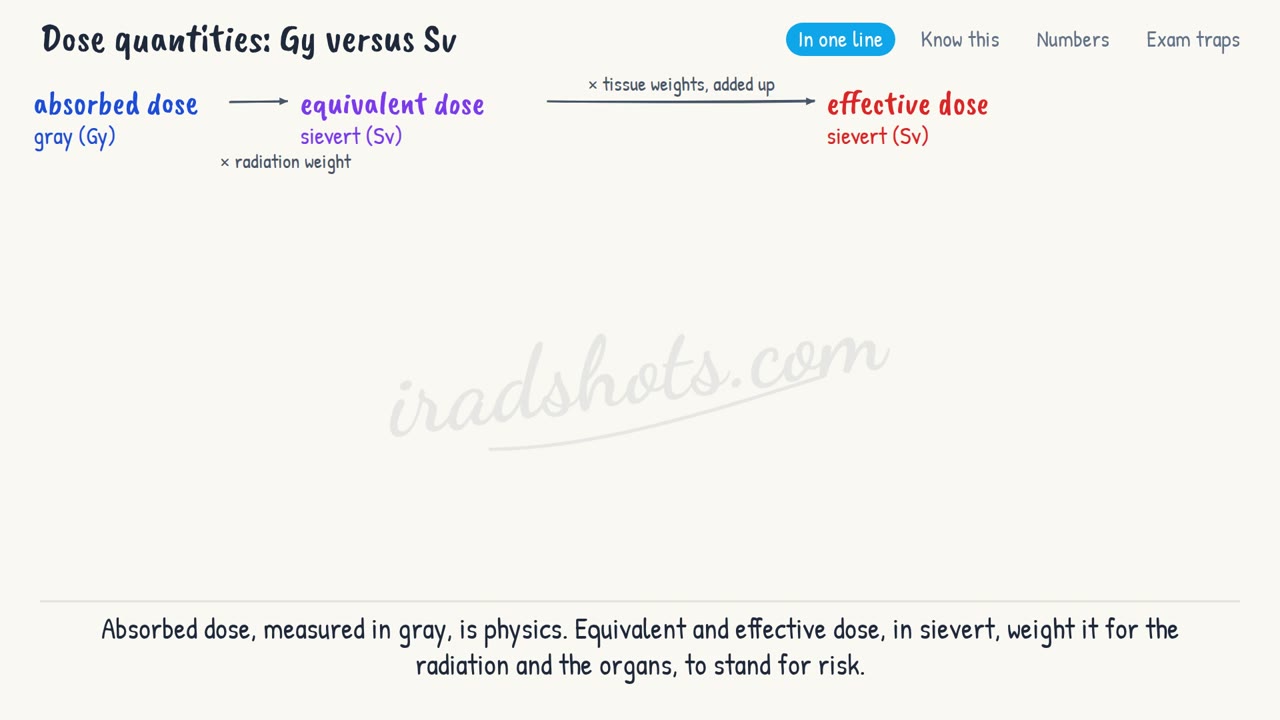
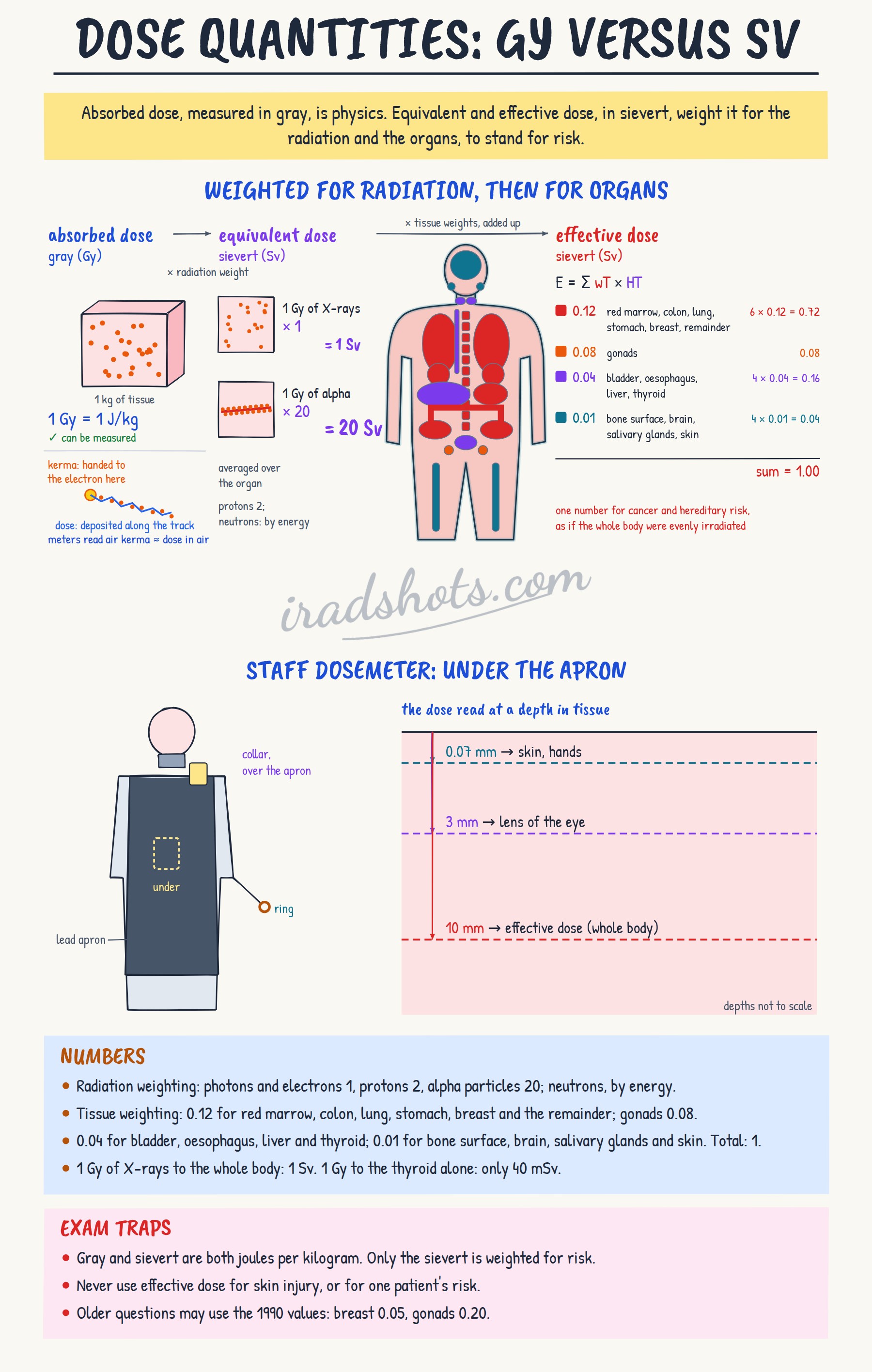
Absorbed dose, measured in gray, is physics. Equivalent and effective dose, in sievert, weight it for the radiation and the organs, to stand for risk.
Know this
- Absorbed dose is energy deposited per unit mass, in gray: one joule per kilogram. It can be measured.
- Kerma is the kinetic energy photons give to electrons, per unit mass, also in gray. Dosemeters measure air kerma, almost equal to the dose in air.
- Equivalent dose is an organ's average absorbed dose times the radiation weighting factor, in sievert: 1 for X-rays, gamma rays and electrons, but 20 for alpha particles.
- Effective dose adds each organ's equivalent dose times its tissue weighting factor. One number for the risk of cancer and hereditary effects, as if the whole body were evenly irradiated.
- It is for comparing examinations, optimisation and limits, for a reference person. It is not one patient's risk, nor skin injury: for that, use the skin's absorbed dose, in gray.
- Entrance surface dose is the skin dose where the beam enters, including backscatter. The dose-area product, or kerma-area product, is the same at any distance from the focus.
- A patient's effective dose is estimated from the dose-area product, the entrance dose, or CT's dose-length product, with coefficients from computer models.
- Staff wear a dosemeter under the apron, read at 10 millimetres depth; 0.07 millimetres stands for skin, and 3 for the lens of the eye.
Numbers
- Radiation weighting: photons and electrons 1, protons 2, alpha particles 20; neutrons, by energy.
- Tissue weighting: 0.12 for red marrow, colon, lung, stomach, breast and the remainder; gonads 0.08.
- 0.04 for bladder, oesophagus, liver and thyroid; 0.01 for bone surface, brain, salivary glands and skin. Total: 1.
- 1 Gy of X-rays to the whole body: 1 Sv. 1 Gy to the thyroid alone: only 40 mSv.
Exam traps
- Gray and sievert are both joules per kilogram. Only the sievert is weighted for risk.
- Never use effective dose for skin injury, or for one patient's risk.
- Older questions may use the 1990 values: breast 0.05, gonads 0.20.
Sketch
Check yourself
As in the exam: mark each item true or false. Any number can be true.
1. Concerning absorbed dose and kerma:
- aEffective dose can be measured with a dosemeter worn by the patient.
Effective dose is always calculated, using weighting factors and models of a reference person.
- bAbsorbed dose takes account of the type of radiation.
It is purely physical; the radiation weighting factor is added in equivalent dose.
- cAbsorbed dose is the energy deposited per unit mass of material.
One gray is one joule per kilogram.
- dAt diagnostic energies, air kerma is very nearly equal to the absorbed dose in air.
The freed electrons travel a tiny distance and lose almost none of their energy as bremsstrahlung.
- eKerma is measured in sievert.
Kerma, like absorbed dose, is a physical quantity in gray.
2. Regarding equivalent dose (ICRP 103):
- aAn absorbed dose of 1 Gy of alpha particles to an organ gives an equivalent dose of 20 Sv.
1 Gy × a weighting factor of 20.
- bThe radiation weighting factor for neutrons depends on their energy.
ICRP 103 gives it as a continuous function of neutron energy.
- cThe radiation weighting factor for protons is 5.
ICRP 103 gives 2; 5 was the older ICRP 60 value.
- dIt is the mean absorbed dose in an organ multiplied by the radiation weighting factor.
Its unit is the sievert.
- eThe radiation weighting factor for X-rays is 20.
It is 1 for X-rays, gamma rays and electrons; 20 is for alpha particles.
3. Concerning effective dose and the ICRP 103 tissue weighting factors:
- aEffective dose is the sum over organs of equivalent dose times the tissue weighting factor.
E = Σ w_T H_T, in sievert.
- bThe breast has a tissue weighting factor of 0.12.
It was 0.05 in ICRP 60.
- cThe tissue weighting factors add up to 1.
So a uniform whole-body equivalent dose equals the effective dose.
- dThe thyroid has a tissue weighting factor of 0.01.
It is 0.04; 0.01 is for bone surface, brain, salivary glands and skin.
- eThe gonads have the largest tissue weighting factor.
Their factor is 0.08; red marrow, colon, lung, stomach, breast and the remainder are 0.12 (gonads were 0.20 in ICRP 60).
4. Regarding the use of effective dose:
- aAn X-ray absorbed dose of 1 Gy to a single organ gives an effective dose of 1 Sv.
Only a uniform whole-body dose does; one organ gives its tissue weighting factor × 1 Sv.
- bIt is the right quantity to predict skin injury after a long fluoroscopic procedure.
Tissue reactions are judged from the absorbed dose to the skin, in gray.
- cAn X-ray absorbed dose of 10 mGy to the thyroid alone gives an effective dose of 0.4 mSv.
10 mGy × 1 × 0.04 = 0.4 mSv.
- dIt gives the cancer risk of the individual patient examined.
It is calculated for a reference person averaged over age and sex.
- eIt is suitable for comparing the doses of different types of examination.
That is one of its main purposes, for a reference person.
5. Concerning dose-area product and the estimation of dose:
- aEffective dose in CT is estimated from the dose-length product with a conversion coefficient.
The coefficients come from computer models of a reference person.
- bEntrance surface dose includes backscatter from the patient.
The backscatter factor is roughly 1.1 to 1.5.
- cA dosemeter reading the personal dose equivalent at 10 mm depth is used for the dose to the lens of the eye.
That uses 3 mm depth; 10 mm estimates effective dose and 0.07 mm the skin.
- dHalving the distance from the focus doubles the dose-area product.
It is unchanged; only the dose and the area change, in opposite directions.
- eThe dose-area product is the same at any distance from the focus.
The area grows with the square of the distance as the dose falls by the inverse square law.
The full explanation about 5 min to read
A ladder of quantities
"Dose" is used loosely; the exam is precise. There is a ladder of quantities, each built on the one before. At the bottom is absorbed dose, in gray. Two weighting steps turn it into quantities meant to stand for risk: equivalent dose and effective dose, both in sievert. Alongside sit practical quantities measured on an X-ray set or read from personal dosemeters.
Absorbed dose and kerma
Absorbed dose, D, is the energy deposited by ionising radiation per unit mass of material. Its unit is the gray: 1 Gy = 1 J/kg. It says nothing about the type of radiation or the organ: it is pure physics, and it can be measured.
Kerma stands for kinetic energy released per unit mass. Photons hand energy to charged particles, mainly electrons, by the photoelectric effect and Compton scatter (lessons L03 and L04). Kerma is their initial kinetic energy per unit mass, counted where they are set moving; absorbed dose is the energy they then deposit, wherever they stop. Kerma is also in gray. At diagnostic energies the freed electrons travel only a tiny distance and lose almost none of their energy as bremsstrahlung, so kerma and absorbed dose are almost equal. Dosemeters are calibrated in air kerma, the standard measured quantity of the X-ray beam, and it closely equals the absorbed dose in air. Dosemeters are lesson L48.
Equivalent dose: the type of radiation
The same absorbed dose does more biological harm if it comes from densely ionising radiation. Equivalent dose to an organ or tissue, H_T, is the mean absorbed dose over that organ multiplied by the radiation weighting factor, w_R. Its unit is the sievert, also a joule per kilogram, but now weighted for harm.
In ICRP Publication 103 (2007), on which current UK law is based, w_R is 1 for photons (X-rays and gamma rays) and for electrons, 2 for protons, and 20 for alpha particles and heavy ions. For neutrons it is a continuous function of their energy. So for diagnostic X-rays the equivalent dose in millisievert equals the absorbed dose in milligray, while 1 Gy of alpha particles to an organ gives 20 Sv.
Effective dose: the organs
Organs differ in their sensitivity. Effective dose, E, is the sum over all organs of each organ's equivalent dose times its tissue weighting factor, w_T: E = Σ w_T H_T. Its unit is also the sievert. The ICRP 103 values are 0.12 for red bone marrow, colon, lung, stomach, breast and the remainder tissues (a group including the kidneys, spleen and small intestine); 0.08 for the gonads; 0.04 for bladder, oesophagus, liver and thyroid; and 0.01 for bone surface, brain, salivary glands and skin. They add up to 1. Older questions may still use the ICRP 60 (1990) values, in which the gonads were 0.20 and the breast 0.05.
Because the weights add up to 1, a uniform whole-body dose of 1 Gy of X-rays gives 1 Sv in every organ and an effective dose of 1 Sv. But 1 Gy to the thyroid alone gives 0.04 × 1 Sv = 0.04 Sv, or 40 mSv. Effective dose is the uniform whole-body dose with the same overall risk of cancer and hereditary effects as the real, uneven exposure. Example: if only the lungs and the breasts received 10 mGy each from X-rays, E = 0.12 × 10 + 0.12 × 10 = 2.4 mSv.
What effective dose is for, and what it is not
Effective dose is calculated for a reference person, averaged over both sexes and all ages. It is the right tool for comparing examinations, techniques and hospitals, for optimisation, and for comparing doses to workers and the public with limits and constraints. (Dose limits are lesson L45; typical doses and risks, L42.)
It is not one patient's own risk: a child or an older adult differs from the reference person. And it does nothing for tissue reactions, the deterministic effects with thresholds (lesson L41), such as skin injury after long interventional procedures. For those, use the absorbed dose to that tissue, in gray. Effective dose cannot be measured; it is always calculated.
Practical quantities on an X-ray set
Entrance surface dose (ESD) is the absorbed dose at the skin where the beam enters, including backscatter from the patient; the backscatter factor is roughly 1.1 to 1.5, depending on the kV, filtration and field size. Without backscatter, it is the incident air kerma.
The dose-area product (DAP), also called the kerma-area product, is the air kerma across the beam multiplied by the beam's area, in units such as Gy cm². A flat ionisation chamber on the collimator measures it. It does not depend on distance from the focus: moving further away, the area grows with the square of the distance while the intensity falls by the inverse square law, so the product stays the same (ignoring absorption in air). It does depend on the field size and the exposure. Patient doses in radiography and fluoroscopy are lesson L50.
Collective dose, the sum of effective doses over a population in person-sieverts, compares practices; it should not be used to predict deaths from tiny doses.
Estimating patient and staff doses
A patient's effective dose is estimated, not measured. A conversion coefficient turns a measured quantity into effective dose: the DAP or the entrance surface dose in radiography and fluoroscopy, or the dose-length product in CT (lesson L57). The coefficients come from Monte Carlo computer models of a reference person.
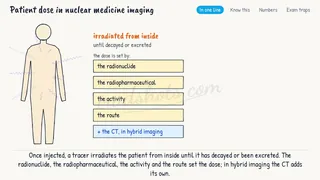
Staff wear a personal dosemeter, usually under the lead apron, which reads the personal dose equivalent at 10 mm depth, Hp(10), as an estimate of effective dose. Hp(0.07), at 0.07 mm depth, stands for the skin and extremities, and Hp(3) for the lens of the eye; a second dosemeter at the collar, over the apron, may be used for the eyes.
Exam traps
One: gray and sievert are both joules per kilogram; only the sievert quantities are weighted for risk. Two: effective dose is never used for skin injury or one patient's risk. Three: know the ICRP 103 weights (breast 0.12, gonads 0.08) and recognise the old ICRP 60 ones. Four: the DAP does not change with distance from the focus.
Sign in to keep track of the lessons you have done and your scores.