IR(ME)R 2017 (1): duty holders
Employer, referrer, practitioner, operator and MPE: roles, entitlement and training; employer's written procedures
The shot
In one line
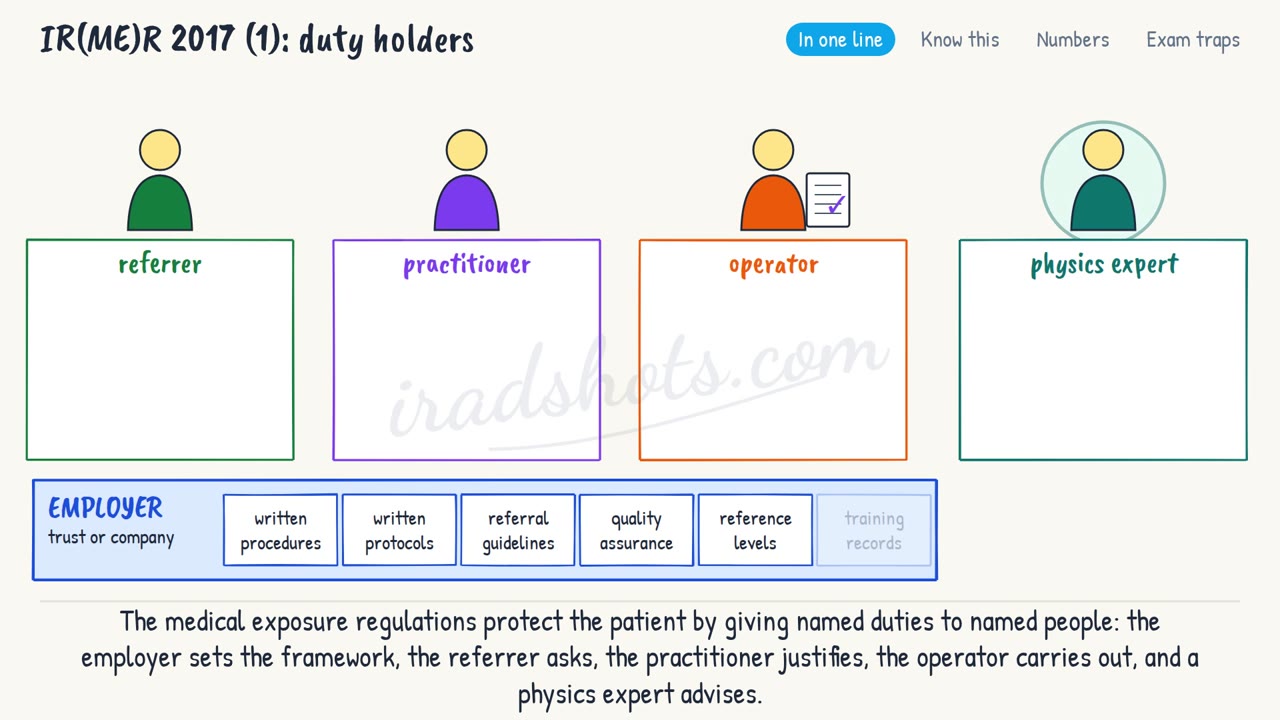
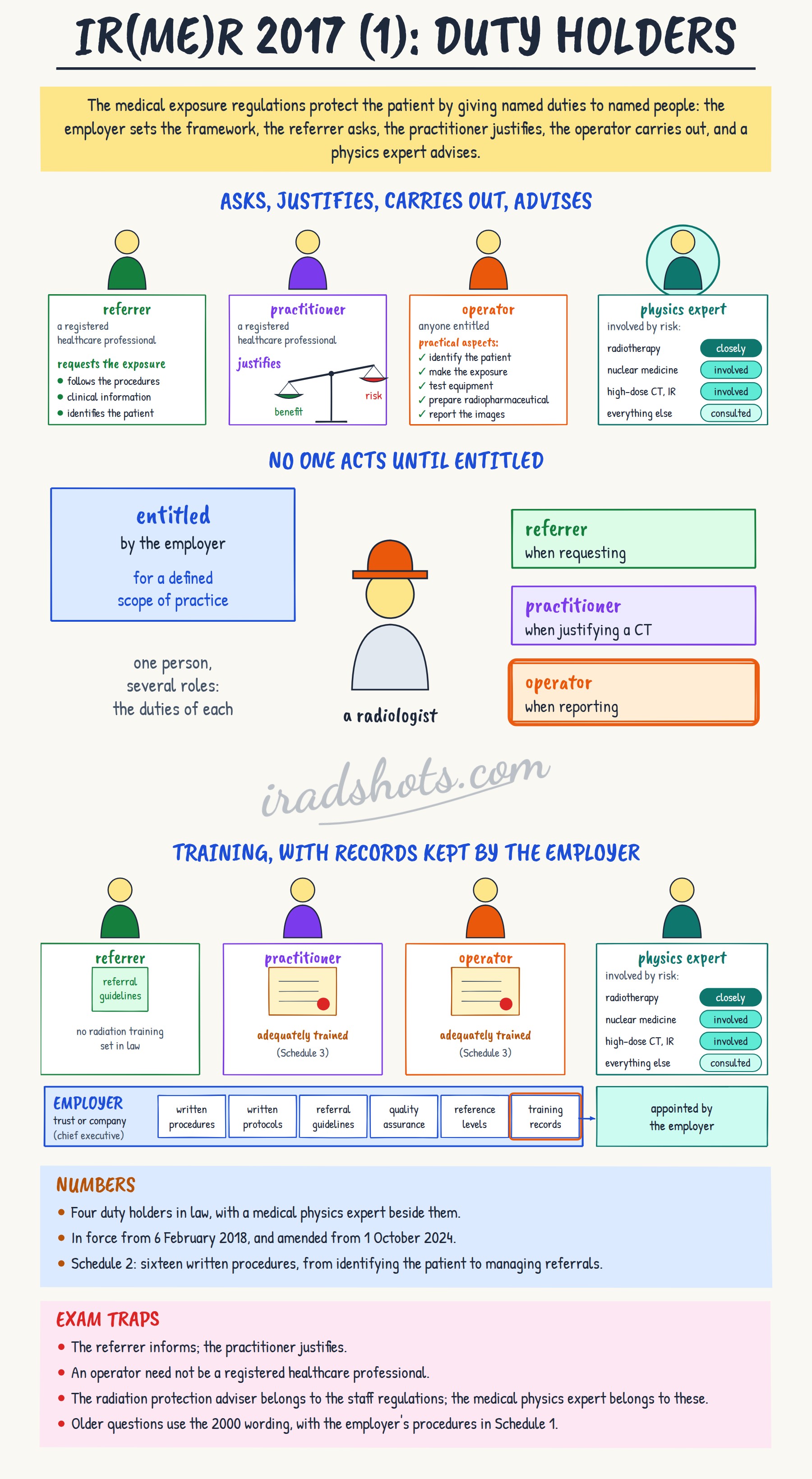
The medical exposure regulations protect the patient by giving named duties to named people: the employer sets the framework, the referrer asks, the practitioner justifies, the operator carries out, and a physics expert advises.
Know this
- The employer, the trust or company, usually acting through its chief executive, provides the framework: written procedures, protocols, referral guidelines, quality assurance and diagnostic reference levels.
- The referrer, a registered healthcare professional, requests the exposure. The referrer must follow the employer's procedures, and give enough clinical information to justify it and to identify the patient.
- The practitioner, also a registered healthcare professional, takes responsibility for justifying the exposure: weighing its benefit against its risk.
- The operator is anyone entitled to carry out a practical aspect: identifying the patient, making the exposure, testing equipment, preparing a radiopharmaceutical, or reporting the images. Each answers for their own part.
- The employer must appoint a medical physics expert, involved according to risk: closely in radiotherapy, involved in nuclear medicine and high-dose work, and consulted on optimisation elsewhere.
- Follow one request. A GP refers a patient for a chest radiograph; a radiographer authorises it under a radiologist's guidelines, identifies the patient and makes the exposure.
- No one acts until the employer entitles them, for a defined scope. One radiologist can be a referrer when requesting, a practitioner when justifying a CT, and an operator when reporting.
- Practitioners and operators must be adequately trained, with records kept by the employer. Referrers need no radiation training in law, but must follow the referral guidelines.
Numbers
- Four duty holders in law, with a medical physics expert beside them.
- In force from 6 February 2018, and amended from 1 October 2024.
- Schedule 2: sixteen written procedures, from identifying the patient to managing referrals.
Exam traps
- The referrer informs; the practitioner justifies.
- An operator need not be a registered healthcare professional.
- The radiation protection adviser belongs to the staff regulations; the medical physics expert belongs to these.
- Older questions use the 2000 wording, with the employer's procedures in Schedule 1.
Sketch
Check yourself
As in the exam: mark each item true or false. Any number can be true.
1. Concerning the employer under IR(ME)R 2017:
- aThe employer must keep up-to-date training records of practitioners and operators.
Regulation 17(4); they must be available for inspection.
- bThe employer can transfer its legal responsibility to a clinical director.
Tasks can be delegated; the legal responsibility cannot.
- cThe employer must have written procedures for the matters listed in Schedule 2.
Regulation 6(1); Schedule 2 lists the minimum set.
- dWritten protocols are needed only for non-standard examinations.
They are needed for every type of standard radiological practice.
- eThe employer must make referral guidelines available to referrers.
Regulation 6(5)(a); they include radiation doses.
2. Regarding the referrer:
- aA referrer must be a doctor.
Nurses, radiographers and other registered professionals can be entitled.
- bA referrer must be a registered healthcare professional.
It is in the definition in regulation 2.
- cThe referrer is responsible for the justification of the exposure.
Justification is the practitioner's duty, unless the referrer is also entitled as practitioner.
- dIR(ME)R requires referrers to complete Schedule 3 training.
Schedule 3 applies to practitioners and operators; referrers follow procedures and guidelines.
- eA referrer must supply enough medical data for the exposure to be justified.
Regulation 10(5).
3. Concerning the practitioner and the operator:
- aReporting an image is a practical aspect carried out by an operator.
Clinical evaluation is a practical aspect.
- bAn operator must be a registered healthcare professional.
Anyone adequately trained and entitled can be an operator.
- cAn operator may authorise an exposure under guidelines issued by a practitioner.
Regulation 11(5); the practitioner keeps the justification.
- dThe practitioner is entitled to take responsibility for the justification of an individual exposure.
This is the definition as amended in 2024.
- eCalibrating equipment is not a practical aspect.
Calibration of equipment is in the definition of practical aspect.
4. Regarding the medical physics expert (MPE):
- aAn MPE is needed only in radiotherapy.
They are also involved in nuclear medicine and high-dose work, and consulted elsewhere.
- bThe MPE and the radiation protection adviser are the same legal role.
The adviser belongs to IRR17; one person may hold both roles.
- cAn MPE's competence must be recognised by the Secretary of State.
It is part of the definition in regulation 2.
- dThe employer must appoint an MPE for every type of exposure.
Regulation 14(1), involved to a degree set by the risk.
- eThe MPE contributes to the analysis of accidental or unintended exposures.
Regulation 14(3)(f).
5. Concerning entitlement and duty holders who hold several roles:
- aEntitlement is for a defined scope of practice.
Schedule 2(b); a scope may be narrow, such as limb radiographs.
- bNobody may act as a practitioner until the employer has entitled them.
Schedule 2(b) requires a procedure identifying entitled duty holders.
- cA radiologist reporting a radiograph is acting as the referrer.
Reporting is clinical evaluation, a practical aspect done as an operator.
- dA radiologist justifying a CT is acting as a practitioner.
Justification is the practitioner's role.
- eA person can hold only one duty holder role.
Regulation 2(2): they carry the duties of every role they hold.
The full explanation about 5 min to read
Where this sits
The Ionising Radiation (Medical Exposure) Regulations 2017 (IR(ME)R, SI 2017/1322) protect people exposed for medical reasons, and those having non-medical imaging with medical equipment. L43 placed them in the UK framework; L44 and L45 covered the staff regulations, IRR17. This lesson is about people: who holds each duty, how they come to hold it, and how they are trained. What they do with each exposure, from justification to incidents, is in L47.
The regulations name four duty holders: the employer, the referrer, the practitioner and the operator. Beside them, regulation 14 makes the employer appoint a medical physics expert (MPE).
The employer (regulation 6, Schedule 2)
The employer is whoever, in the course of a trade, business or other undertaking, carries out exposures or practical aspects at a radiological installation, or engages others to do so. In the NHS it is the trust or health board; in private practice the company. The Royal College of Radiologists (RCR) advises that a senior accountable person is designated, in NHS services generally the chief executive. Tasks can be delegated, for example to a clinical director, but the legal responsibility cannot.
The employer provides the framework. It must have written procedures for the matters in Schedule 2: sixteen of them since 2024, including identifying the patient correctly, identifying who is entitled to act as referrer, practitioner or operator, pregnancy enquiries, clinical evaluation, and, new in 2024, clinical audit and making, amending and cancelling referrals. It must ensure where appropriate that written protocols exist for every type of standard radiological practice; the government's guidance recommends they are specific to each examination and machine. It must establish referral guidelines, including radiation doses, and make them available to referrers; establish quality assurance programmes for its procedures and protocols (equipment quality assurance is in L14); review diagnostic reference levels and make them available to operators; and take steps to ensure that practitioners and operators are adequately trained and keep up their training.
The referrer
A referrer is a registered healthcare professional entitled by the employer's procedures to refer individuals to a practitioner for exposure. Regulation 10(5) requires the referrer to give the practitioner enough medical data, such as previous imaging or records, for the practitioner to decide whether there is a sufficient net benefit. The RCR guidance adds that the referral should identify the patient and give the relevant history, and pregnancy or breastfeeding status where relevant. Since 2024 regulation 10(1) states outright that the referrer, like the practitioner and operator, must comply with the employer's procedures.
The practitioner
A practitioner is a registered healthcare professional entitled to take responsibility for the justification of an individual exposure; the words "the justification of" were added in 2024. Justification, deciding that the benefit outweighs the detriment, is the practitioner's central duty, using the referrer's information. Practitioners are usually radiologists, but radiographers are often entitled within a limited scope. Practitioners for nuclear medicine also need a licence (L51).
The operator
An operator is anyone entitled to carry out a practical aspect of an exposure. There is no need to be a registered healthcare professional. Practical aspects include identifying the patient, handling the equipment and making the exposure, assessing technical parameters and dose, calibrating and testing equipment, preparing and giving radiopharmaceuticals, image processing, and the clinical evaluation, defined since 2024 as interpreting the information from an exposure, including its outcome and implications. Each operator is responsible for each practical aspect they carry out, and for any authorisation they give under guidelines issued by a practitioner. Practitioner and operator share the duty to optimise.
The medical physics expert (regulation 14)
An MPE is an individual or group with the knowledge, training and experience to advise on radiation physics applied to exposure, recognised by the Secretary of State. The employer must appoint one and involve them according to risk: closely in radiotherapy, involved in nuclear medicine and in high-dose interventional radiology and CT, and involved as appropriate for consultation on optimisation in all other practices. The MPE advises on dosimetry, measurements and equipment, and contributes to optimisation and diagnostic reference levels, quality assurance and acceptance testing, the analysis of accidental or unintended exposures, training, and compliance. The government's guidance expects the MPE to be entitled as an operator. The radiation protection adviser (L44) belongs to IRR17 and protects staff and the public; the same physicist may hold both roles.
Entitlement and several roles
No one may act as a duty holder until the employer has entitled them, individually or as a staff group, for a defined scope of practice, after training and assessment of competence. One person may hold several roles, and then carries the duties of each (regulation 2(2)). A radiologist requesting a further examination is a referrer, justifying a CT is a practitioner, and reporting images is an operator performing clinical evaluation.
Training (regulation 17, Schedule 3)
Practitioners and operators must not act without adequate training, theory and practice in the subjects of Schedule 3 relevant to their work. Trainees may take part under supervision. The employer must keep up-to-date training records, available for inspection. IR(ME)R sets no training requirement for referrers, but they must work to the employer's procedures and referral guidelines, and awareness training is good practice.
One request
A GP, entitled as a referrer, requests a chest radiograph with the clinical details. A radiographer authorises it under guidelines issued by a radiologist, who remains the practitioner, then identifies the patient and makes the exposure as an operator. Whoever reports the image performs the clinical evaluation as an operator. For a CT, a radiologist may justify the request personally as practitioner.
Exam traps
The referrer supplies information; the practitioner justifies. Operators need not be registered healthcare professionals. The MPE is not the radiation protection adviser. IR(ME)R 2000 said the practitioner took responsibility for an "individual medical exposure", listed the employer's procedures in Schedule 1 and training in Schedule 2, and called non-medical imaging "medico-legal exposures".
Sign in to keep track of the lessons you have done and your scores.