MR safety (1): the UK framework
MHRA guidance (5th ed. 2026 note), MR Responsible Person, MR Safety Expert, MR Authorised Persons, MR Environment and Controlled Access Area, MR Safe/Conditional/Unsafe/Unlabelled, implants and off-label scanning
The shot
In one line
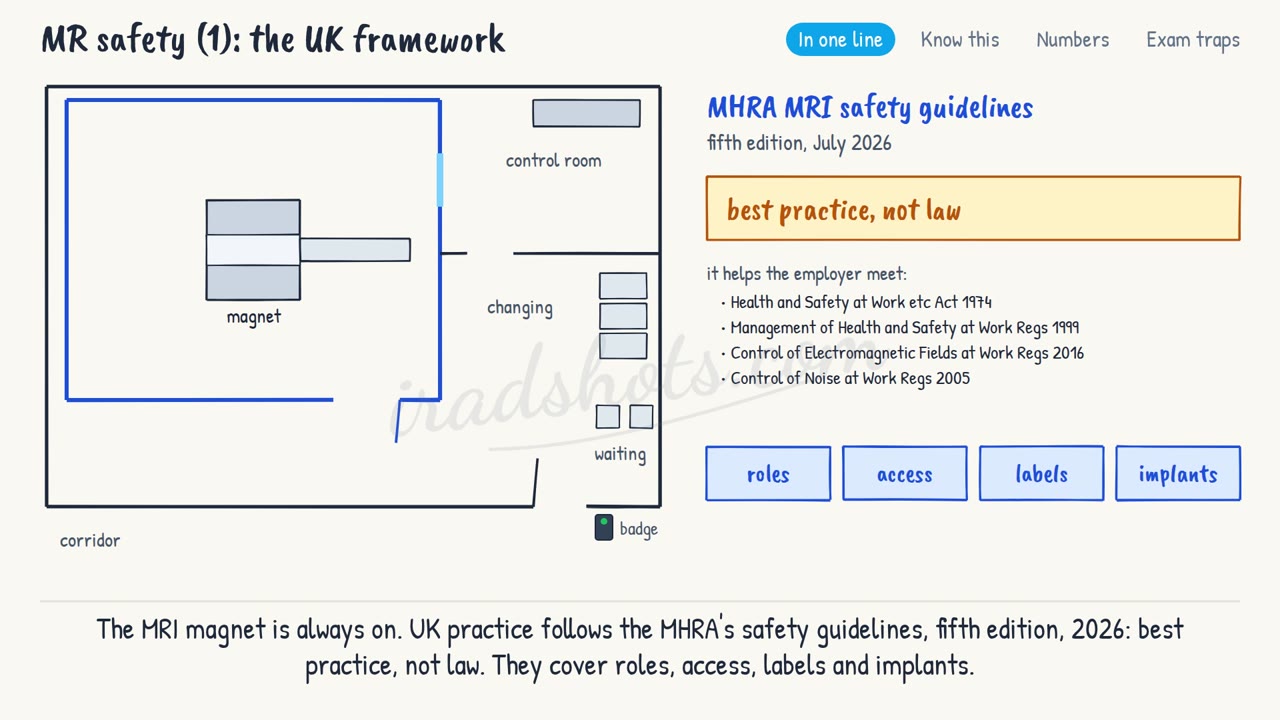
The MRI magnet is always on. UK practice follows the MHRA's safety guidelines, fifth edition, 2026: best practice, not law. They cover roles, access, labels and implants.
Know this
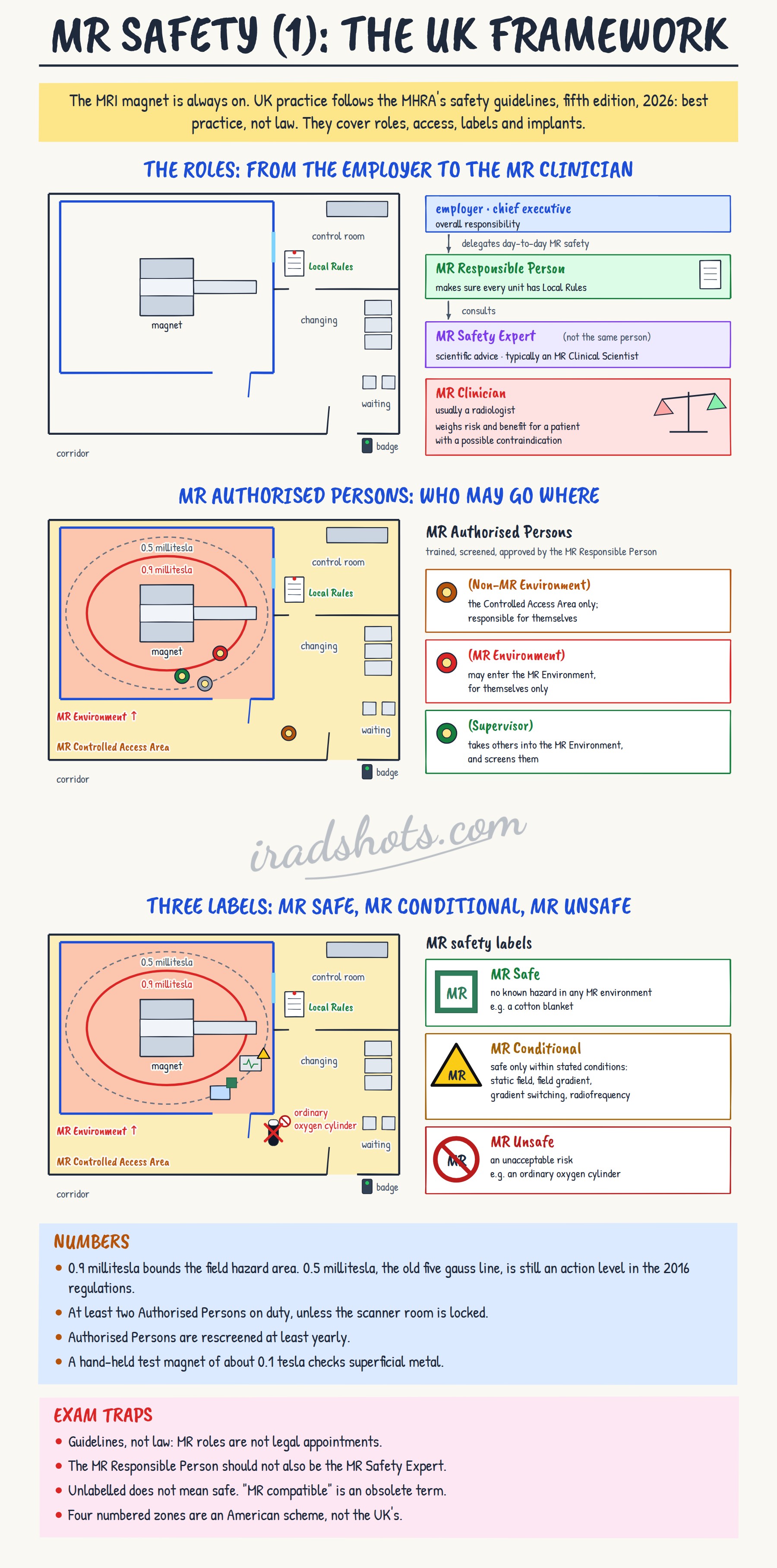
- The employer keeps overall responsibility. The chief executive delegates day-to-day MR safety to an MR Responsible Person, who makes sure every unit has Local Rules.
- The MR Responsible Person consults an MR Safety Expert, typically an MR Clinical Scientist. The MR Clinician, usually a radiologist, weighs risk and benefit for a patient with a possible contraindication.
- The MR Controlled Access Area is a buffer zone with badge-controlled access. Inside it, the MR Environment holds the shielded scanner room and the field above 0.9 millitesla.
- MR Authorised Persons are trained, screened staff. Some stay in the Controlled Access Area; some may enter the MR Environment alone; a Supervisor may take others in.
- Everyone else is screened by a Supervisor at every visit: on the referral, at booking, the full form on arrival, and at the door.
- MR Safe, a green square, has no known hazard. MR Conditional, a yellow triangle, is safe only within stated conditions. MR Unsafe, a red circle, includes an ordinary oxygen cylinder.
- An item with no label is MR Unlabelled, treated as MR Unsafe. A pillow may hide springs.
- An implant's make and model are found before the visit, or a generic procedure covers low-risk implants. Otherwise, off-label scanning needs a team risk assessment, and the MR Clinician decides.
Numbers
- 0.9 millitesla bounds the field hazard area. 0.5 millitesla, the old five gauss line, is still an action level in the 2016 regulations.
- At least two Authorised Persons on duty, unless the scanner room is locked.
- Authorised Persons are rescreened at least yearly.
- A hand-held test magnet of about 0.1 tesla checks superficial metal.
Exam traps
- Guidelines, not law: MR roles are not legal appointments.
- The MR Responsible Person should not also be the MR Safety Expert.
- Unlabelled does not mean safe. "MR compatible" is an obsolete term.
- Four numbered zones are an American scheme, not the UK's.
Sketch
Check yourself
As in the exam: mark each item true or false. Any number can be true.
1. Concerning the status of the MHRA MRI safety guidelines in the UK:
- aFollowing them helps the employer comply with the Health and Safety at Work etc Act 1974.
They support that Act and the regulations under it.
- bThey have the force of law, like the Ionising Radiations Regulations 2017.
They are best practice; MRI uses no ionising radiation.
- cDelegating day-to-day MR safety removes the employer's responsibility.
The employer keeps overall responsibility for safety.
- dThe Control of Electromagnetic Fields at Work Regulations 2016 are relevant to MRI units.
They are among the laws the guidelines help users comply with.
- eThe MR Safety Expert is a legal appointment like the radiation protection adviser.
MR roles come from guidance, not from regulations.
2. Regarding roles in a UK MRI unit:
- aThe MR Responsible Person should also act as the MR Safety Expert.
They consult the expert but should not take that role.
- bThe MR Clinician makes the risk-benefit decision for a patient with a possible contraindication.
At most sites the MR Clinician is a radiologist.
- cThe MR Safety Medical Adviser routinely answers individual patient safety queries.
They give medical input to policy, not individual queries.
- dThe MR Safety Expert is typically an MR Clinical Scientist.
They give scientific advice on all aspects of MR safety.
- eThe MR Responsible Person must ensure that Local Rules are in place for every MRI unit.
They are written in consultation with the MR Safety Expert.
3. Concerning access to an MRI unit:
- aAn MR Authorised Person (Non-MR Environment) may enter the MR Environment alone.
They need an MR Authorised Person (Supervisor).
- bMR Authorised Persons must be screened again at least annually.
Records are kept by the MR Responsible Person.
- cThe MR Controlled Access Area contains the MR Environment.
It is a buffer zone around it with restricted access.
- dThe MR Environment is now bounded by the 0.5 millitesla contour.
Its field hazard area is now set by the 0.9 millitesla contour.
- eUnrestricted access to the MR Controlled Access Area is limited to MR Authorised Persons.
All others are screened and supervised.
4. Regarding screening and the labelling of equipment:
- aA patient scanned last month need not be screened again.
Screening is repeated at every attendance.
- bAn unlabelled sandbag can be assumed to be MR Safe.
Unlabelled items are treated as MR Unsafe; sandbags may hold metal pellets.
- cAn MR Conditional item is safe only within its stated conditions.
Such as static field strength, spatial field gradient and RF exposure.
- dRelatives accompanying a patient must be screened before entering the MR Controlled Access Area.
Everyone is screened, even if not entering the MR Environment.
- eAn ordinary oxygen cylinder is MR Conditional.
It is MR Unsafe: such cylinders have caused deaths in MR scanner rooms.
5. Concerning patients with implants:
- aAn off-label risk assessment includes an MR Radiographer, an MR Safety Expert and the MR Clinician.
That is the minimum multidisciplinary team.
- bGeneric implant safety procedures allow some low-risk implants to be scanned without knowing the make and model.
They are approved under local governance.
- cThe make and model of an implant should be known before the appointment.
This gives time to confirm its MR safety status.
- dA patient with an MR Unsafe implant can never be scanned.
Off-label scanning is allowed if the benefit outweighs the risk.
- eThe off-label decision rests with the MR Referring Clinician.
The MR Clinician takes the final responsibility.
The full explanation about 5 min to read
Why a framework
The magnet is always on (L62). Its field makes projectiles of ferromagnetic objects and can upset implants; scanning adds nerve stimulation, heating and noise. Those hazards are L78. Here is how a UK department is organised against them, following the Medicines and Healthcare products Regulatory Agency (MHRA) "Safety Guidelines for Magnetic Resonance Imaging Equipment in Clinical Use", fifth edition, July 2026.
Guidance, not law
The guidelines are best practice, not law. MRI uses no ionising radiation, so IRR17 and IR(ME)R (L43 to L47) do not apply, and no MR role is a legal appointment like the radiation protection adviser. They help the employer comply with the Health and Safety at Work etc Act 1974, the Management of Health and Safety at Work Regulations 1999, the Control of Electromagnetic Fields at Work Regulations 2016 and the Control of Noise at Work Regulations 2005. The employer keeps overall responsibility for safety.
Who is responsible
The MR Responsible Organisation, responsible for the use and maintenance of the MR system, is usually the employer. The chief executive should delegate day-to-day management of MR safety to an MR Responsible Person, most effectively the clinical director, head of department, clinical scientist or lead MRI radiographer. The MR Responsible Person must ensure that Local Rules are in place for every MRI unit and that risk assessments are made every year, and keeps the list of MR Authorised Persons. They should consult an MR Safety Expert but not be one.
The MR Safety Expert gives scientific advice on all aspects of MR safety: typically an MR Clinical Scientist, registered and certified. The MR Clinician, at most sites a radiologist, has clinical oversight of the patient and makes the individual risk-benefit decision when there is a possible contraindication. The MR Safety Medical Adviser, a doctor, advises on policy, not individual patients. The MR Referring Clinician must declare implants on the referral: referrers are the first line of defence. The MR Radiographer is responsible for the entire episode of care.
Two areas
The MR Controlled Access Area is a locally defined area large enough to contain the MR Environment: a buffer zone between it and the outside world. Doors stay closed; access is by ID badge, for example. Unrestricted access is for MR Authorised Persons only; everyone else is screened first and supervised inside.
The MR Environment is the three-dimensional volume around the magnet containing the Faraday-shielded scanner room and the B0 hazard area, where the static field can cause harm. It is now bounded by the 0.9 millitesla contour (an international standard of 2022, adopted in the UK in 2024). It used to be 0.5 millitesla, the "5 gauss line" of older questions, and 0.5 millitesla remains an action level under the 2016 regulations for risk assessment. The four numbered zones belong to the American College of Radiology.
MR Authorised Persons
An MR Authorised Person is a trained, screened member of staff formally approved by the MR Responsible Person, with unrestricted access to the Controlled Access Area. Sites may divide them into three: (Non-MR Environment), the Controlled Access Area only, responsible for themselves; (MR Environment), may enter the MR Environment for themselves and supervise others only outside it; and (Supervisor), may supervise others in the MR Environment and screen them. An MR Operator may also run the scanner. Screening is repeated at least annually. Nobody should work alone in the MR Environment; the MHRA recommends at least two authorised persons in the Controlled Access Area unless the scanner room is locked.
Screening patients
Patients, relatives and carers are screened by a Supervisor before entering the Controlled Access Area, at every attendance. Four stages are recommended: questions on the referral, at booking, the full form on arrival, and a visual and verbal check just before the magnet room.
Labelling equipment
Marking follows the ASTM F2503 standard. MR Safe (a green square): no known hazard in any MR environment; only items that are non-conducting, non-metallic and non-magnetic. MR Conditional (a yellow triangle): safe within defined conditions, such as static field strength, spatial field gradient, gradient switching and radiofrequency exposure; they must be read and met before the item goes in. MR Unsafe (a red circle crossed through): unacceptable risk, such as ferromagnetic scissors or an ordinary oxygen cylinder. MR Unlabelled: no label, treated as MR Unsafe until shown otherwise; pillows may contain springs and sandbags metal pellets. "MR compatible" is no longer used. A hand-held magnet of about 0.1 tesla tests superficial metal.
Patients with implants
Active implants need an energy source: cardiac devices, neurostimulators, cochlear implants, pumps. Passive ones do not: joints, valves, clips, stents. The make and model should be known before the appointment, and every site needs an implant procedure. Generic implant safety procedures let low-risk implants be scanned without the make and model, under local governance. Off-label scanning covers an MR Conditional device whose conditions cannot be met, an MR Unsafe or unlabelled device, or one of unknown status. It may go ahead if the benefit outweighs the risk, after a risk assessment by at least an MR Radiographer, an MR Safety Expert and the MR Clinician, with precautions, a suitable clinician present and a check afterwards. The MR Clinician takes the final responsibility.
Operating modes and pregnancy
The scanner runs in Normal mode, First Level Controlled mode (entered deliberately by the operator) or Second Level Controlled mode (with research ethics approval); their limits are in L78.
Pregnant patients are scanned in Normal mode whenever possible, with 1.5 T preferred in the first trimester where both are available, and gadolinium avoided unless clinically essential (L79). Pregnant staff may continue normal duties but, as a precaution, leave the scanner room during acquisition.
Exam traps
The MR roles are not legal appointments. The MR Responsible Person manages, the MR Safety Expert advises, the MR Clinician decides for the patient. Unlabelled means unsafe. Older questions use the 5 gauss line, numbered zones, or "MR compatible".
Sign in to keep track of the lessons you have done and your scores.