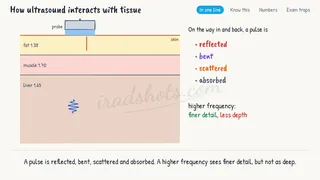
Ultrasound waves
Mechanical longitudinal waves, frequency, wavelength and speed in tissue, elasticity and density, acoustic impedance, intensity, power and decibels
The shot
In one line
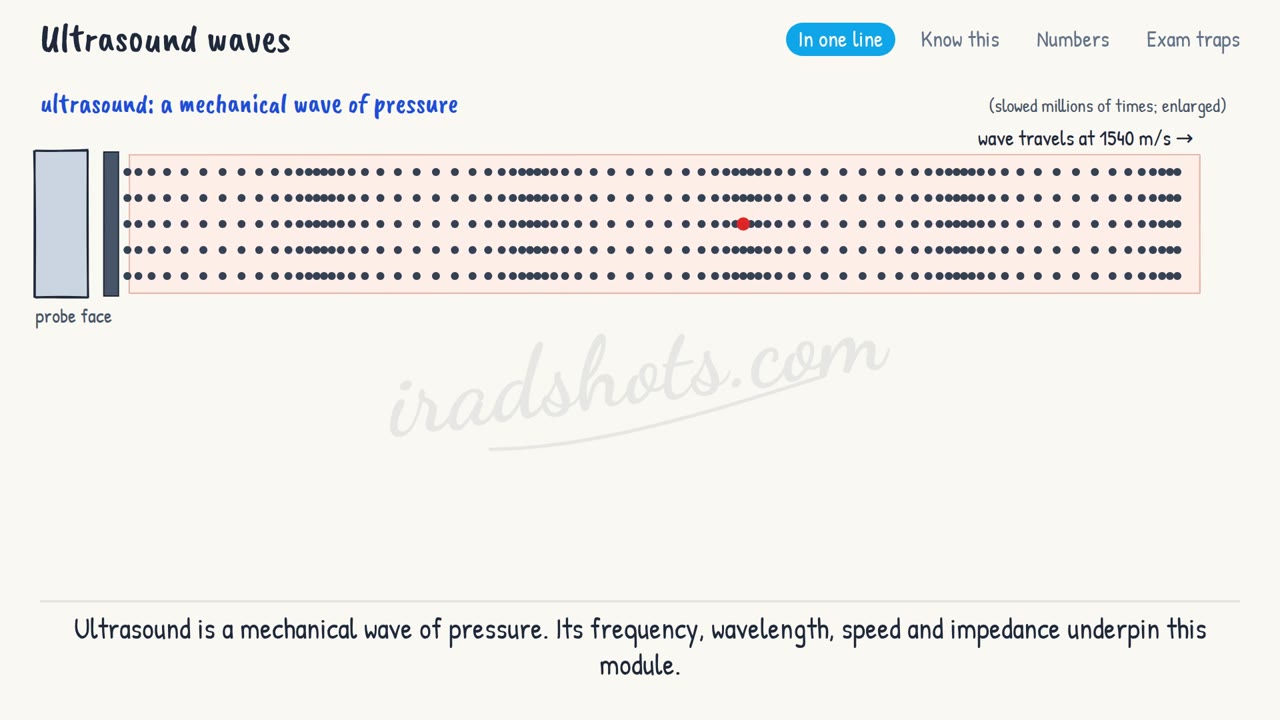
Ultrasound is a mechanical wave of pressure. Its frequency, wavelength, speed and impedance underpin this module.
Know this
- Sound is a mechanical wave: it needs a medium. In tissue the particles swing to and fro along the direction of travel, in bands of compression and rarefaction. It carries energy, not matter.
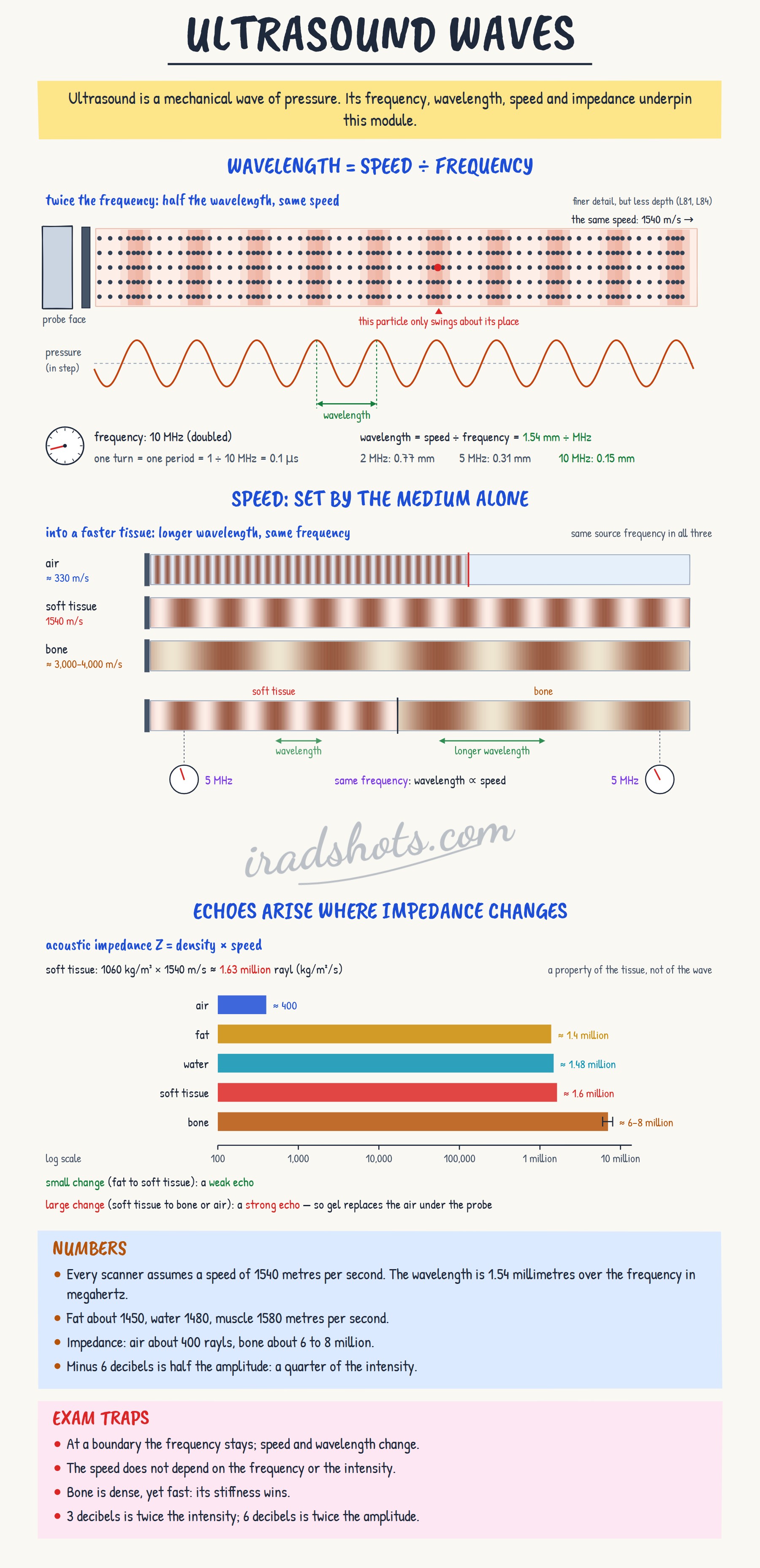
- Ultrasound is sound above 20 kilohertz; imaging uses about 2 to 15 megahertz. The source sets the frequency; it does not change from tissue to tissue. The period is one over the frequency.
- Wavelength is speed divided by frequency: in soft tissue, 0.77 millimetres at 2 megahertz, 0.15 at 10. Double the frequency: half the wavelength, finer detail, less depth.
- The speed is set by the medium alone: the square root of stiffness over density. Stiffness varies far more, so bone is fast although it is dense.
- Sound travels at about 330 metres per second in air, 1540 in soft tissue, and 3 to 4 thousand in bone. In a faster tissue the wavelength is longer, at the same frequency.
- Acoustic impedance is density times speed, a property of the tissue: near 1.6 million rayls in soft tissue, several times higher in bone, thousands of times lower in air. Echoes arise where it changes.
- Intensity is power per unit area, and goes as the square of the pressure amplitude. At a focus the same power crosses a smaller area: a higher intensity.
- Decibels compare two intensities: ten times the log of their ratio. Minus 3 decibels is half, minus 10 a tenth, minus 20 a hundredth. Decibel losses add.
Numbers
- Every scanner assumes a speed of 1540 metres per second. The wavelength is 1.54 millimetres over the frequency in megahertz.
- Fat about 1450, water 1480, muscle 1580 metres per second.
- Impedance: air about 400 rayls, bone about 6 to 8 million.
- Minus 6 decibels is half the amplitude: a quarter of the intensity.
Exam traps
- At a boundary the frequency stays; speed and wavelength change.
- The speed does not depend on the frequency or the intensity.
- Bone is dense, yet fast: its stiffness wins.
- 3 decibels is twice the intensity; 6 decibels is twice the amplitude.
Sketch
Check yourself
As in the exam: mark each item true or false. Any number can be true.
1. Concerning the nature of ultrasound:
- aIn soft tissue it is a longitudinal wave.
The particles move to and fro along the direction of travel.
- bThe particles of tissue travel with the wave from the probe to the reflector.
Each particle only oscillates about its resting place; the wave carries energy, not matter.
- cBone can carry shear waves as well as compression waves.
Solids resist being sheared; soft tissue carries only very slow shear waves.
- dIt needs a medium to travel through.
It is a mechanical wave; unlike X-rays it cannot cross a vacuum.
- eUltrasound is sound below 20 kilohertz.
It is sound above 20 kilohertz, beyond human hearing.
2. Regarding frequency, period and wavelength:
- aDoubling the frequency doubles the wavelength.
At the same speed, the wavelength halves.
- bA shorter wavelength allows finer detail.
The wavelength sets the finest detail an image can show.
- cIn soft tissue the wavelength at 5 megahertz is about 0.3 millimetres.
1.54 millimetres divided by 5 is about 0.31 millimetres.
- dDiagnostic imaging uses frequencies of about 2 to 15 megahertz.
Higher frequencies still are used for very superficial work.
- eThe period at 5 megahertz is 5 microseconds.
The period is one over the frequency: 0.2 microseconds.
3. Concerning the speed of sound:
- aIt equals the square root of stiffness over density.
Stiffness here is the bulk modulus, the resistance to compression.
- bIt rises with the frequency.
It is set by the medium alone, not by the frequency.
- cIt is slower in bone than in soft tissue because bone is denser.
Bone is much stiffer, so it is faster: about 3000 to 4000 metres per second.
- dIt rises with the intensity of the wave.
Loudness does not change the speed.
- eIt is about 330 metres per second in air.
Air is very easily compressed.
4. When a wave passes from soft tissue into bone:
- aThe wavelength increases.
Wavelength is speed over frequency, and the speed rises.
- bThe speed increases.
Bone is stiffer, roughly 3000 to 4000 against 1540 metres per second.
- cThe period of the wave lengthens.
The period is one over the frequency, and the frequency does not change.
- dThe frequency increases.
The frequency is set by the source and does not change.
- eThe acoustic impedance increases several times.
Bone is about 6 to 8 million rayls, soft tissue about 1.6 million.
5. Regarding impedance, intensity and decibels:
- aAcoustic impedance is a property of the wave, set by its frequency.
It is a property of the tissue.
- bA fall of 6 decibels halves the intensity.
It halves the amplitude, a quarter of the intensity.
- cIntensity is proportional to the pressure amplitude.
It is proportional to the square of the amplitude.
- dA fall of 3 decibels halves the intensity.
10 times the log of one half is about minus 3.
- eAcoustic impedance is density times speed.
Its unit is kilograms per square metre per second, the rayl.
The full explanation about 5 min to read
What a sound wave is
Sound is a mechanical wave. Unlike X-rays and radio waves, which cross a vacuum (L01), it needs a medium. The vibrating face of the probe pushes on the tissue next to it, which pushes on its neighbours, and so the disturbance is handed on. Each particle only oscillates about its resting place. The wave carries energy, not matter.
In fluids and soft tissue the wave is longitudinal: the particles move to and fro along the direction in which the wave travels. Where they crowd together the pressure is higher, a compression; where they spread apart it is lower, a rarefaction. These bands travel away from the probe. Solids such as bone also carry shear (transverse) waves, with sideways motion; soft tissue carries only very slow ones, a few metres per second, which shear-wave elastography measures (L89).
Frequency and period
The frequency is the number of oscillations each second, in hertz. Ultrasound is sound above the range of human hearing, above 20 kilohertz. Diagnostic imaging uses about 2 to 15 megahertz, and higher frequencies still for very superficial work. The period is the time of one oscillation, one over the frequency: 0.2 microseconds at 5 megahertz.
The frequency is set by the source. As the wave passes from one tissue to the next it does not change: each particle is driven by its neighbour at the same rate, so as many waves leave a boundary each second as arrive. How the probe makes its pulse belongs to L82.
Speed: set by the medium
The speed of sound depends on the medium alone. It does not depend on the frequency or on how loud the wave is. For a fluid or soft tissue, speed equals the square root of the stiffness divided by the density. The stiffness here is the bulk modulus, the resistance to being compressed. A stiffer medium springs back harder and passes the disturbance on faster; a denser one has more mass to move and passes it on more slowly.
From one material to another, stiffness varies far more than density. That is why stiff materials are fast although they are dense. Air is light but very easily compressed: sound crosses it at only about 330 metres per second. Fat carries it at about 1450, water at about 1480, muscle at about 1580, and bone, dense but very stiff, at roughly 3000 to 4000. The soft tissues differ by only a few per cent; their average, 1540 metres per second, is the value every scanner assumes to turn echo time into depth (L84).
Wavelength
The wavelength is the distance between neighbouring compressions. Wavelength equals speed divided by frequency. In soft tissue, 1540 metres per second divided by 1 megahertz is 1.54 millimetres, so the wavelength in millimetres is 1.54 divided by the frequency in megahertz: 0.77 millimetres at 2 megahertz, 0.31 at 5 and 0.15 at 10.
Because the frequency stays fixed, a wave entering a faster tissue has a longer wavelength there, in proportion to the speed. From soft tissue into bone, the wavelength roughly doubles or more.
The wavelength matters because it sets the finest detail an image can show (L84): this is why high frequencies are wanted. Attenuation, which rises with frequency, is why they cannot always be had at depth (L81).
Acoustic impedance
Acoustic impedance, Z, is the density times the speed of sound. Its unit is kilograms per square metre per second, the rayl. It is a property of the tissue, not of the wave. Soft tissues all lie close to 1.6 million rayls: about 1060 kilograms per cubic metre times 1540 metres per second gives about 1.63 million. Fat is a little lower, about 1.4 million, bone several times higher at about 6 to 8 million, and air several thousand times lower, at about 400.
Echoes arise where the impedance changes. A small change, as between fat and other soft tissue, gives a weak echo; a large change, as at soft tissue and bone or air, gives a strong one. That is why gel must replace the air between the probe and the skin. How much is reflected belongs to L81.
Power, intensity and amplitude
The pressure amplitude is the largest swing of pressure from its resting value. The power is the energy the whole beam carries each second, in watts or milliwatts. The intensity is the power per unit area, in milliwatts per square centimetre, and it is proportional to the square of the pressure amplitude: double the amplitude and the intensity quadruples. The same power squeezed into a smaller area, as at the focus of a beam (L83), gives a higher intensity. So intensity varies from place to place in the beam and, in a pulsed beam, from moment to moment; the measures used for safety belong to L90.
Decibels
Decibels compare two intensities on a logarithmic scale: decibels equal ten times the log of the ratio of the intensities, or twenty times the log of the ratio of the amplitudes. Both give the same number, because intensity goes as amplitude squared. Minus 3 decibels is half the intensity, minus 10 a tenth, minus 20 a hundredth and minus 30 a thousandth. Minus 6 decibels is half the amplitude, which is a quarter of the intensity.
Decibels add where ratios multiply. A wave that loses 10 decibels on its way in and 10 more on its way back has lost 20 decibels: it has a hundredth of its intensity. This is why attenuation and receiver gain are always quoted in decibels (L81, L84, L85).
Exam traps
One: at a boundary the frequency stays the same; the speed and wavelength change. Two: the speed depends on the medium only, not on the frequency or intensity. Three: bone is denser than soft tissue yet faster, because it is much stiffer. Four: 3 decibels is a factor of two in intensity, 6 decibels a factor of two in amplitude.
Sign in to keep track of the lessons you have done and your scores.